
How many acres of land is used as farmland in Canada?
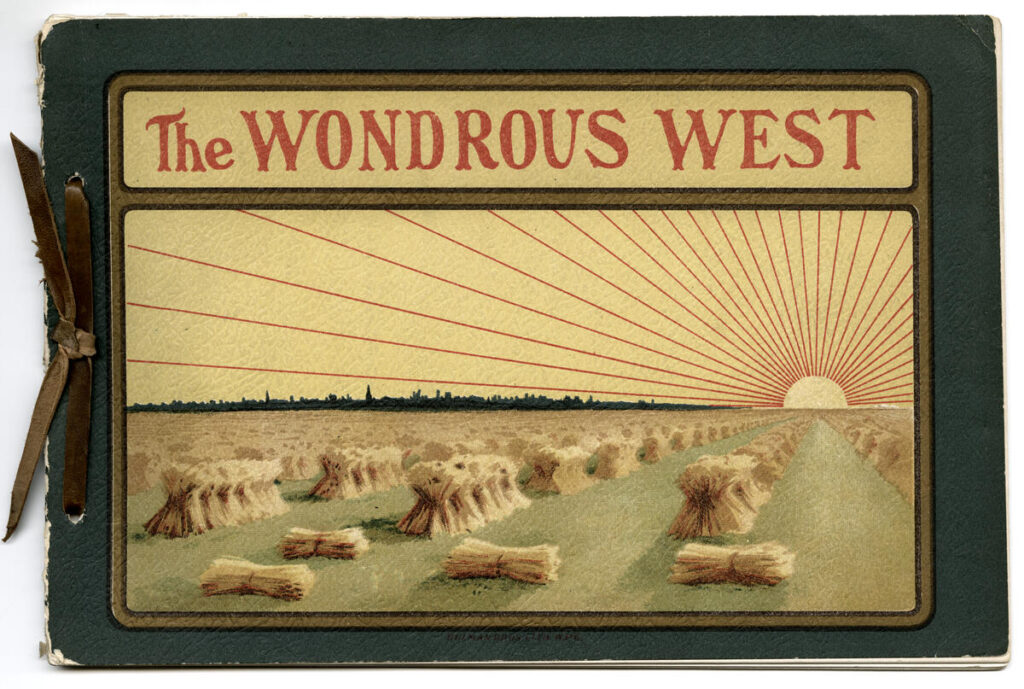
Cover photo: CU179196 Courtesy of Libraries and Cultural Resources Digital Collections, University of Calgary

build these competencies


factors that influenced population growth in the west
The construction of the trans-Canada railroad from the eastern provinces through the prairies and to the Pacific Ocean made transportation and travel easier. To complete the railway, western land and other natural resources were brought under the control of the federal government. The government granted a large area of land on either side of the railway to the Canadian Pacific Railway.
This land was very valuable to the railway because closeness to a railway station was essential to wheat farmers in the days before gas-powered trucks were invented.
The CPR was originally supposed to come north through the Saskatchewan River valleys, where the best land was to be found. Farmers had rushed into this northern area because of its reputation for fertile land. However, the CPR changed the route to instead come through the southern part of what is now Alberta. This left many farmers hundreds of kilometres from a rail link.
Although bringing more settlers to this land increased the movement of people, supplies and farm equipment from the east to the west, it disregarded and violated treaty agreements made with Indigenous people.
The photo at the top of this slide shows passengers and train at the Grand Trunk Pacific and Canadian Northern Station in Edmonton, about 1913.
The photo to the right shows some materials that were used to complete the railway tracks loaded on wagons during the construction of the Canadian Pacific Railway on the prairies. Bunk cars – used for sleeping by workers – are shown in the background.
 In what ways was the construction of the trans-Canada railway a form of colonization?
Photo: CU178915 Courtesy of Libraries and Cultural Resources Digital Collections, University of Calgary
The Dominion Lands Act of 1872 made the provision of free homesteads for settlers possible. The main attraction for immigrant farmers was 160 acres (64.7 hectares) of free land. Under the Dominion Lands Act of 1872, homesteaders received free land as long as they improved it, grew crops and lived on it for three years. They only needed to pay a $10 registration fee. Between 1870 and 1930, about 625 000 land patents were provided to homesteaders.
What have you learned about the range of places from which settlers immigrated to the Canadian west?
The photo shows the opening of the Dominion Lands Office in Grande Prairie in about 1910. In many early communities across the prairies, settlers lined up to receive a parcel of land.
Photo: CU193435 Courtesy of Libraries and Cultural Resources Digital Collections, University of Calgary
The Department of Interior was created in 1873 to promote immigration to the Prairies.
Sir Clifford Sifton, the Minister of the Interior, believed that immigration was essential to build the new country of Canada. As a result of his policies, the annual number of immigrants entering Canada rose from 16,835 to 141,465 between 1896 to 1905.
Clifford Sifton was responsible for increasing immigration, making sure land in the prairies was settled and building “a nation of good farmers.” To do this, he simplified land grants for settlers and offered bonuses to companies that recruited immigrants. He also promoted and organized tours of the west for journalists and used brochures and posters to advertise the prairies to farmers who needed land.
Sifton wanted immigration agents and recruiters to attract people whom he believed would be more likely to remain in Canada through difficult times. He considered people from eastern and central European countries to be more suitable and discouraged the immigration of Jewish people, Italians, Asians, African Americans and English people from cities. As he promoted this approach, Sifton described what he considered to be an ideal settler.
 When I speak of quality I have in mind something that is quite different from what is in the mind of the average writer or speaker upon the question of immigration. I think that a stalwart peasant in a sheepskin coat, born on the soil, whose forefathers have been farmers for ten generations, with a stout wife and a half-dozen children, is good quality.
The photo shows settlers from the United States crossing the western prairies, heading for the wheat fields in about 1906.
Photo: C-011553 National Library of Canada
The establishment of the North-West Mounted Police (NWMP) was meant to bring “law and order” to the western prairies. The NWMP were part of the government’s strategy to claim the land in the west with European farmers.
The photo shows a Canadian Pacific Railway construction camp and a North-West Mounted Policeman on a horse at Moose Jaw, Saskatchewan.
Photo: CU178925 Courtesy of Libraries and Cultural Resources Digital Collections, University of Calgary
images of farming
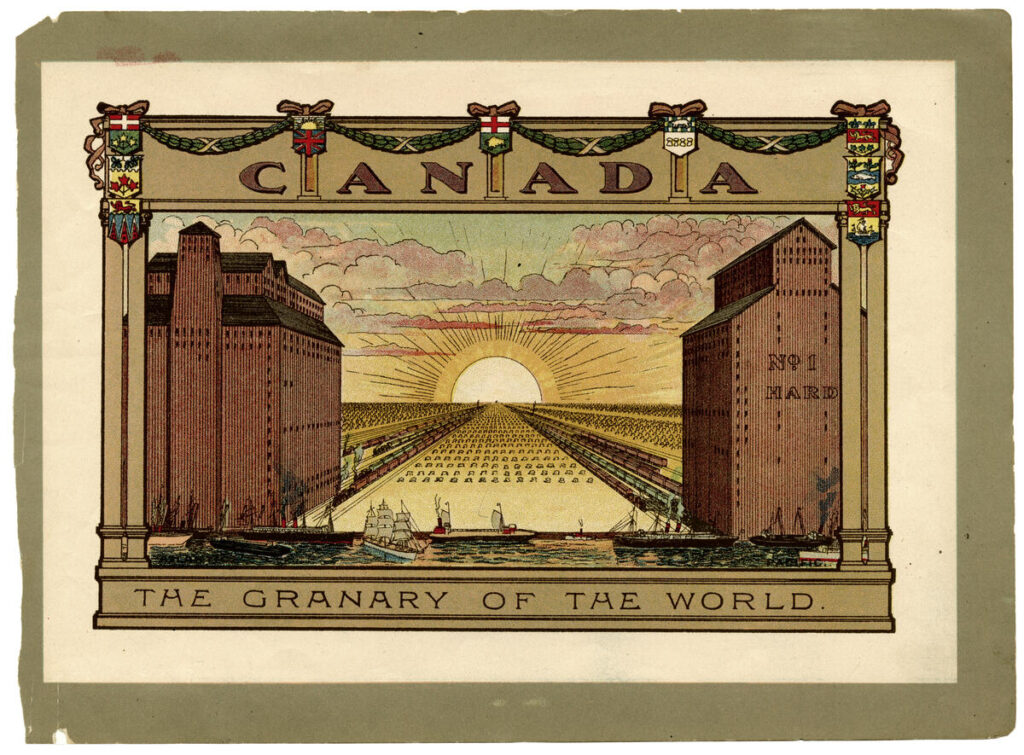
The lure of free farmland was one of the most important influences bringing people from European countries to western Canada. Images of the Canadian west and of a farming way of life were created by the government. These images emphasized opportunities they thought people from Europe would find most appealing. The government also represented western land as empty, vast and available for the taking.
This is referred to as terra nullius, which was a belief held by Europeans and used to justify the colonization of Indigenous peoples. This belief stated that the land could be occupied because there was nobody there, other than plants and animals.
Even though First Nations people lived on the land, the government believed the land was empty because they thought First Nations people were not using that land in a “civilized” manner. The land, therefore was considered to be terra nullius and could be claimed and owned.
Images courtesy of Libraries and Cultural Resources Digital Collections, University of Calgary